


Anatomy of a Backbend - Part 1

Updated: Feb 9
Updated 9th February 2026
Welcome to our next anatomy series on the backbend! 🌈
Due to the shear volume of information in this series we will be breaking it up into 3 bite size sections to understand:
Basics of a back bend & the cervical spine (neck)
The thoracic spine (upper back) & shoulders
The lumbar spine (lower back), pelvis & hips
Let's begin!
When someone mentions a backbend the usual thought that comes to mind is the backbend bridge position, aka the wheel.

But backbending comes in all different shapes and sizes and can include tricks both on and off the pole. There are some backbends that are assisted by gravity and others that are resisted by gravity.


And there are some that require a long shoulder lever (open shoulder), others that require a short shoulder lever position (closed shoulder) and others that require no shoulders at all! (We will talk about these later on!)
So, you can imagine when sitting down to write this blog we wanted to talk about the specific anatomy of a backbend but also wanted to make it applicable to backbends of all the above listed positions.
But most importantly we want to help you understand the concept of mindful movement when training flexibility or contortion based skills. Mindful movement, aka kinaesthesia, is simply defined as a person's awareness of the position and movement of the parts of the body by means of sensory organs (proprioceptors) in the muscles and joints. Engaging certain sequencing of muscles in a backbend will assist in smoother quality of the movement, provide greater control, likely reduce risk of injury and lead us to the desired shape of the end position.

So by applying the anatomical and kinaesthetic knowledge to the physiological movements of back bending, we can train and get flexible smarter.
We have divided this anatomy series into the key areas of a spine and will work through each section individually. These anatomical and kinaesthetic foundational knowledge can then be applied to each type of backbend.
The Ground Rules
When learning any trick, we want to establish ground rules to begin learning and progressing in as safe a manner as possible. Afterall, safety is sexy.
When working on any back bending trick/position it’s important to listen to what our body is telling us. And as soon as we begin to place our body in these positions, we need to be cognisant of our muscles and joints along with any confusing or distressing symptoms our body may be giving us.
For each area of our body we will flag symptoms that we do not want to be feeling either during or immediately after our back bend. These are listed in each section as yellow flags (ie. stop movement immediately, monitor the symptoms and speak to a healthcare professional) or as red flags (i.e seek medical assistance immediately).
Whilst the risk of these symptoms occurring is low, we are working with contortion positions (particularly movements like chest stands), so these symptoms may occur. Not trying to scare everyone reading this blog away from backbending, but just being mindful there are symptoms we need to constantly be on the lookout for and listen to if they do occur.
If you have a pre-existing medical condition/injury or you’re unsure as to whether back bending is suitable for you, then chat to your healthcare professional and contortion/flexibility coach to decide. This blog series is not tailored healthcare/medical advice nor does it provide you with tailored advice so that you can determine if you’re medically clear to backbend. And remember, pain is never ok in contortion or flexibility. Please seek direct guidance from your healthcare professional. Remember our online healthcare team are always here to help.
Ok, now that the ground rules are set, let’s begin!
Pot of gold
As mentioned earlier when I first think of the classic backbend, I think of the rainbow or bridge position.

Our goal in this position, like in every other backbend, is to try to touch every part of the rainbow with our spine. We do this by distributing the load through the whole curve of the spine and focusing on creating length in the spine before creating depth in our arch.
When backbending we want to avoid compression of one specific of the spine, commonly referred to in the physio world as ‘hinging’. But instead we aim to spread the load of the bend. There are 4 common places we hinge in the spine when performing a backbend which are:
1. The alanto-occipital joint (joint of the skull & first point of the cervical spine)
2. The cervico-thoracic joint (joint of C7-T1)
3. The thoraco-lumbar joint (joint of T12-L1)
4. The lower lumbar spine (between L1-5)

We will discuss the anatomical reason why hinging occurs in each relevant area of the spine throughout the series. But what’s important to understand right now for back bending is that adequate intervertebral joint movement needs to occur of every joint.
In layman’s terms, intervertebral movement refers to the amount of accessory motion (involuntary) that occurs between every joint of the spine. When our spine moves correctly our joints will slide and glide on top of each other to extend. And what’s really interesting to note is the amount of movement that occurs at each level of the spine is different!

So, to all those out there wondering why their upper back (thoracic) doesn’t bend as much as their lower back; well it’s not supposed to! And this is why when we aren’t utilising the maximum range of our entire spine, we will have different areas of our spine that attempt to take up the slack. But more on this later.
This concept of avoiding hinging or compression of the spine at one particular joint throughout a backbend takes us back to our earlier point of bending with mindful movement. Improving your mind to muscle connection when training for a backbend will help to:
1. Ensure good entire spinal intervertebral movement to create a beautiful rainbow backbend appearance, and
2. Keep you clear of injury
How do we improve our body’s natural kinaesthesia and ensure we are activating the correct muscles in our backbend?
By learning from a good flexibility coach of course! And using great resources like this blog to help understand more about your body.
So let’s now focus on spinal anatomy, and ideal/efficient mechanics of each key area.
The Cervical Spine (Neck)
The cervical spine contains 7 vertebral bodies (C1 – atlas, C2 – axis, C3-7), with the atlanto-occiput joint being the joint of the skull and the first vertebral body. This first joint allows for ~25 degrees of total spinal flexion/extension which can explain why it is commonly a hinging point of the spine during a backbend. The other joints in the cervical spine provide between 10-20 degrees of movement each, allowing for a total of ~120 degrees of cervical extension. The neck is able to provide so much extension because of the orientation of our facet joints.

Next thing that’s important to know is that every area of our body has stabiliser muscles and mover muscles (check out our core blog, if you haven’t already, to learn more!). Our stabiliser muscles are often our deepest muscles positioned right over or next to the spine, crossing ~ 1-2 joints at time, whilst our moving muscles are much larger, sit on top of our stabilisers and are a great deal bigger in size.
To perform a backbend, we need both our stabilisers and movers to work. Specifically, we need our deep stabiliser muscles to control and assist the accessory movements of the joints to allow our bigger muscles to perform the bulk and power of the movement.
In the cervical spine our stabiliser muscles are our:
Multifidus
Rotatores
Suboccipital muscles (rectus capitis posterior major/minor, obliquus capitus superior/inferior)
Deep neck flexors (longus capitis, longus colli)


The multifidus, rotatores and suboccipital muscles sit on the back of the neck whilst the deep neck flexors sit in front of the neck. An important bit of information to know here is that our deep neck flexors sit right on the cervical spine, behind the trachea and oesophagus. This knowledge is important to know for later on. Together these muscles provide local spinal support as we move our neck through it's range of motion from flexion to extension.
Cervical kinematics in a backbend
So now we understand anatomy, we want to take a look at where can things can go wrong in a backbend. Because our first joint of our neck has a great deal of extension, it’s common from backbenders to try to lead into a backbend with this movement first.
Leading with the upper cervical spine in some can lead to hinging and compression of the atlanto-occipital joint. This is turn may cause localised joint pain, visual disturbances, dizziness, nausea and you guessed it - headaches! Cervical referred headaches can occur from compression of our nerves that exit directly underneath the skull. When the nerves are compressed or irritated, there is a convergence of pain signals onto the nerves that supply the skin of our skull, creating pain at a distant site. This is how we can experience pain at the front of our head/face that comes from our neck (see headache convergence patterns graphic below).

Placing the neck into upper cervical extension first or completely relaxing into end of range exercise extension when backbending places our neck muscles on stretch and can reduce active contraction of our deep neck stabiliser muscles. This can make it more challenging for them to perform their job of stabilisation. And what we know well enough now is if our body can’t access our stabiliser muscles to support the joints it will try it's best to stabilise the spine in a different way. This often tends to occur by the move muscles taking over to create a fake sense of support!
Unlike our stabilisers which sit behind our trachea, our mover muscles sit on top. So when we start our backbend which active engagement of our stabilisers, the bigger scalenes, sternocleidomastoid and hyoid muscles will tend to contract to protect us. Sounds helpful right? Sometimes yes, sometimes no! This contraction can lead to active muscular compression of the trachea in an already stretched position, which for many people can explain why the sense of panic, the breathlessness and even the sensation of choking in these positions.


Now it’s certainly not an instant fix if we’re experiencing these symptoms, but beginning with re-training our cervical spine engagement patterns is a good way to start working towards the end goal of breathing easier in backbends.
Whilst backbending we want to aim to maintain engagement through our deep neck flexors. This way, even if we are extending our neck to it's full range of motion, the stabilisers will remain active, helping to keep the movers relaxed which is turn ensures that the trachea isn't as compressed and will be able to pass a greater amount of air through it. And we won't feel so puffed out!
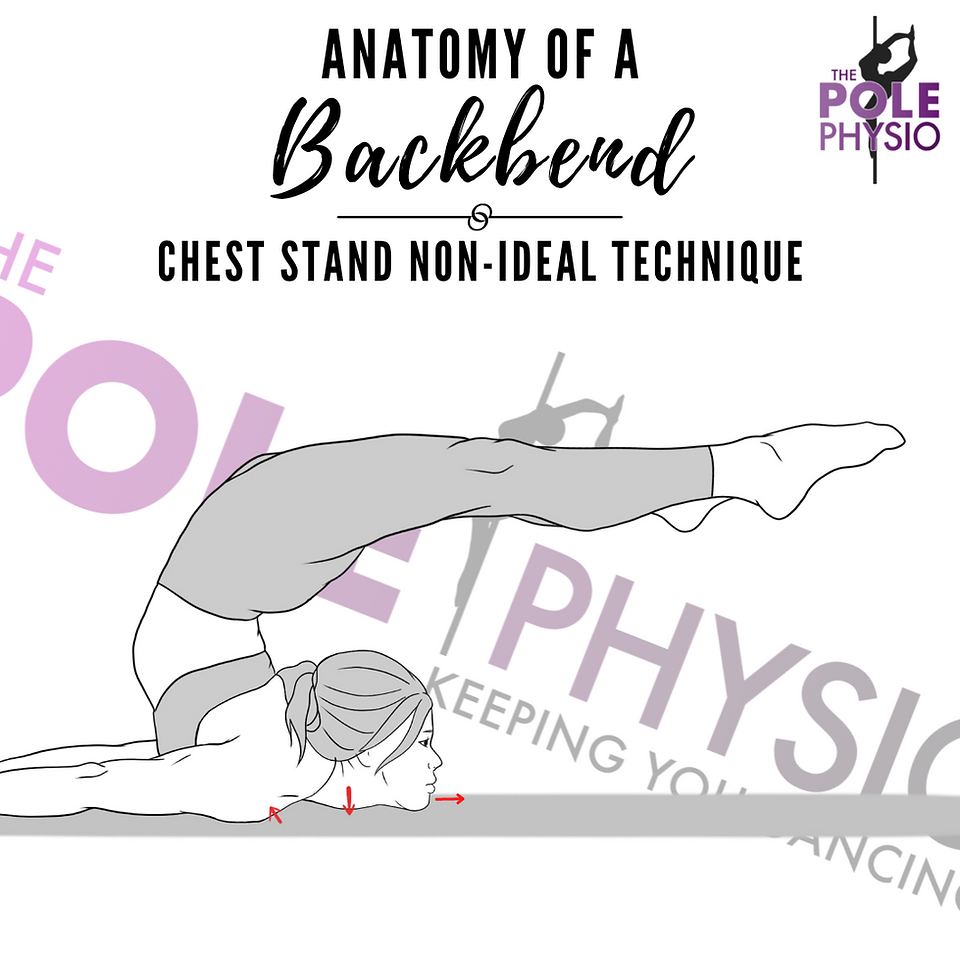
Ever wondered what to do with the neck in a chest stand? In these movements it appears the neck is passively taken into full extension to allow a backbend. But gravity assisted backbends are never fully passive! Even in these positions we are aiming to engage the deep neck flexor stabiliser muscles by pressing the chin gently into the floor. We always want to find a way to keep our muscles active and reduce passive end of range load on our joints

On that note, backbending, particularly contortion style backbends, do not come without risk. So it's important that we are aware of the signs to look out for that tell us to immediately stop backbending and seek medical assistance:
Yellow Flags of the Cervical Spine from backbends:
Any of the following symptoms that appear during backbends but don’t persist afterwards:
Pain in the neck, especially through the upper cervical region
Headaches
Light headedness
Visual disturbances such as dots, tunnel vision or stars
Tingling of the arms/hands
Ringing or a rushing sensation of the ears
Red Flags of the Cervical Spine from backbends:
Any of the following symptoms that persist after back bending for more than 5-10 minutes:
Pain in the neck, especially through the upper cervical region
Severe headaches (without a past history)
Light headedness
Tingling of the arms/hands
Ringing or a rushing sensation of the ears
Please note symptoms that require immediate medical attention are (call 000 or 112):
Facial weakness
Arm weakness
Difficulty speaking/swallowing
Visual disturbances such as loss of vision, dots, tunnel vision or stars that do not ease after ceasing the activity
As mentioned above, the risk of these occurring is present with all types of backbends, no matter how experienced you are. So take it slow in your journey and always listen to your body.
Well that's a wrap for part 1 of our backbending series. As you can see there's quite a lot to it! Join us on the blog as we breakdown the rest of the backbend over part 2 and 3 of our backbend series
Lacking flexibility or experiencing difficulty with your backbending?
Online telehealth appointments can be booked with the Pole Physio Team and our Flexibility Coaches via our ‘Book Online’ page that can be found here. Assessment and tailored rehabilitation are provided in accordance with best practice and evidence-based treatment to help you unleash your 'poletential'.
Until next time, train safe
The Pole Physio
x
Please Note:
Any artwork on this or other pages of https://www.thepolephysio.com is copyrighted and is not be reproduced without written permission per the terms of use and conditions.
This trick should ONLY be undertaken if your instructor has deemed you ready to work on it. This information is general advice only and we are not liable for any injuries that may occur during training.
This page has been created to provide wonderful knowledge with the pole community and sharing of this page to pole friends and pole related facebook groups is actively encouraged.


