


Anatomy of a Backbend - Part 2

Updated: Feb 9
Updated: 9th February 2026
Welcome to Part 2 of our backbending series. Before continuing to read this blog, make sure you've read part 1 of our series which can be found here.
Up to date? Alright! Part 2 will now cover the role of the thoracic spine & shoulders in a backbend.
Thoracic spine (Upper and Mid Back)
Now most contortionists, poler dancers and aerialists that 'walk' through our virtual appointment door lament the fact that their upper back is as stiff as a board. It would have to be one of the biggest flexibility issues we see when it comes to back bending. But as we explained in our first blog, the thoracic spine doesn’t actually have that much extension. Our body actually naturally flexes forward at the thoracic spine and doesn't tend to bend backwards.
In fact, compared to each cervical vertebrae that provides anywhere between 10-25 degrees of extension movement, the thoracic spine provides only 1-6 degrees of extension per joint, contributing a maximal total of ~25 degrees of extension when correctly taken to its end of range.

Why such a lack of extension compared to the neck and lower back? Well this is due to anatomical variation and differences. The spinous processes of the thoracic spine (the bony ridges of the spine) are much longer and downwardly slope, providing a physical block to flexibility. Furthermore, our facet joints are orientated to encourage rotational movements and not extension based movements.

An interesting point to note however is that the spinous processes and the facet orientation change as we go further down the spinal column. As we get close to T10 onwards our back is able to achieve greater movement into extension as we begin to transition towards the lumbar vertebrae and our ribs are floating ribs.
And unlike our neck or our lumbar spine, our upper back has one of the biggest limiting factors to extension – our ribcage! Our ribcage and sternum houses our vital organs and has a purpose of providing stability to this area.
But this comes with a few downsides including our body being designed to be the stiffest where we are most vulnerable (lucky thing it is too) and difficulty inhaling and expanding the ribcage when placed at its end range of motion in a backbend.
This means we require a greater amount of conscious muscle engagement (aka mindful movement) to get our upper back moving the way we want to get use out of every joint of the spinal joint!

In our thoracic spine, our stabilisers are the multifidus and rotatores muscles that continue on from the cervical spine. And our mover muscles are the thoracic paraspinals and all the bigger muscles that surround the shoulder blades, ribs and vertebrae.
But there’s more…
See when we refer to the thoracic spine in a backbend, we can’t solely just refer to the ribcage, sternum and spine. We also need to include the scapulothoracic joint. This is the term we give the shoulder blade sitting in space on the upper back. We have previously delved quite deep into shoulder anatomy so we won’t be going into full depth with today’s blog, but what’s important to know is that our shoulder blades can to some degree physically impede our back bending movement if they aren’t moved out of the way.

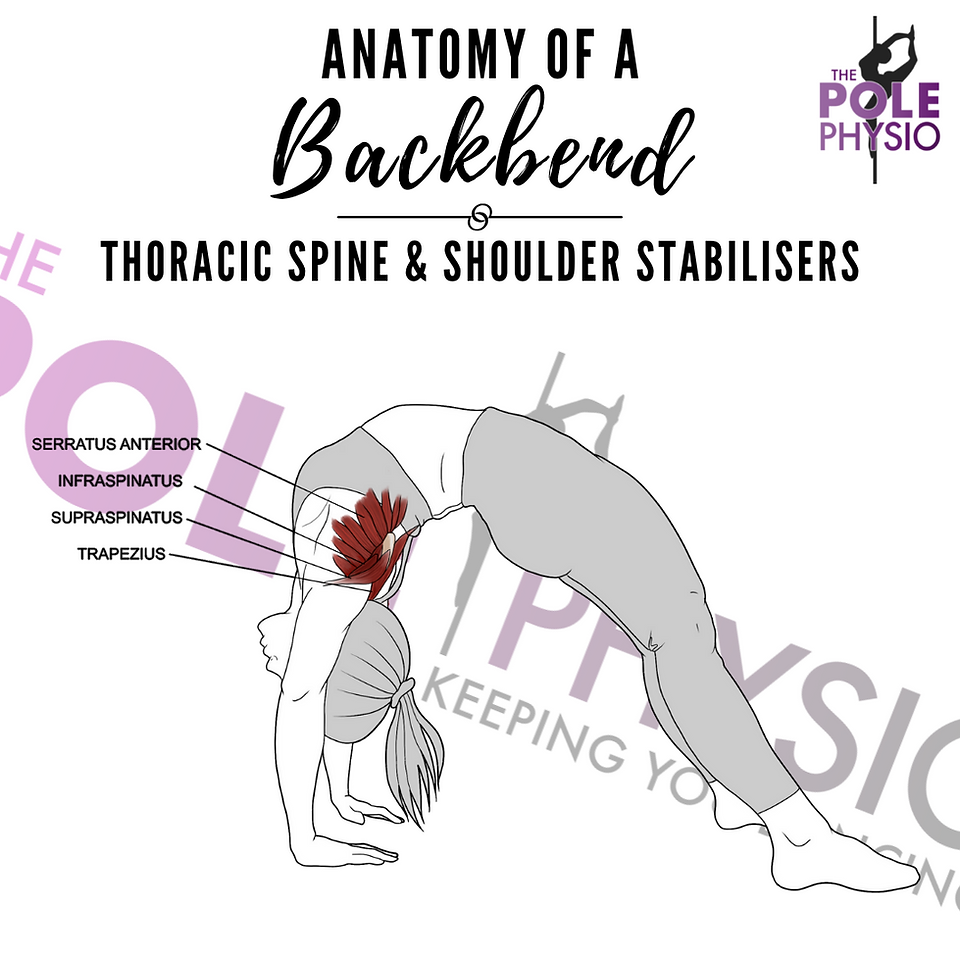
The key take home message here is to use our muscles to engage our shoulder blades and move them out of the way to access greater thoracic extension. The stabilisers of our scapulothoracic joint are our rotator cuff muscles & rhomboids, whilst our movers are primarily the serratus anterior, upper trapezius and lower trapezius muscles.
Cues for thoracic and scapula kinematics in a backbend
We aim to engage both the stabilisers of the thoracic and scapulothoracic joint together as they are heavily intertwined as we are moving our spine into a backbending.
This can be done in a 3-step process:
1. Shrug (upward rotation and elevation)
2. Wrap (scapula protraction)
3. Extend/squeeze (engage the thoracic paraspinal muscles)
Similar to our cue in our cervical spine, we aren’t aiming for a 100% maximal contraction but rather an engagement and sensation that our shoulder blades are being lifted and wrapped out of the way


How do we know how much shrug or wrap to perform? Well, this depends on the type of backbend you are performing. With open shoulder backbends (bridge), the shoulder blade requires at least 60 degrees of scapula upward rotation and elevation, whilst closed arm backbends (elbow backbend) won’t require as much upward rotation and elevation, but will still require protraction. And unsurprisingly, chest stands won’t require shrugs or upward rotation because we aren’t moving our arms, so we instead will have to rely heavily on the proximal strength of the thoracic spine muscles to achieve this range of motion.


Each of these positions will create different sensations of engagement because we are working through different weight bearing structures. So working towards creating a stable and strong foundation of these areas will help us to achieve maximal back bending range. Which is why we will keep coming back to the concept of mindful movement. Can you feel your shoulders shrug and wrap away? And can you feel your upper back muscles engage together in a backbend?
Notice its harder to feel what’s going on in these areas? That’s because the back of our body has less representation on the homunculus (sensory part of our brain) and we visually can’t see it! Film yourself to help improve those mind to muscle connections.
Flags during backbends
Just like our neck, we need to be conscious of any untoward signs when backbending and stop immediately if we feel them. If you experience any of the following when backbending then seek medical help.
Yellow Flags of the Thoracic Spine from backbends:
Any of the following symptoms that appear during backbends but don’t persist afterwards:
- pain or discomfort of the ribs or thoracic spine
- shortness of breath
Red Flags of the Thoracic Spine from backbends:
Any of the following symptoms that persist after back bending for more than 5-10 minutes:
- pain or discomfort of the ribs or thoracic spine
- pain with breathing, sneezing or coughing
- Shortness of breath
And that's a wrap for part 2 of our backbending series. We are now on the home stretch. Join us in part three as we discuss the lower back and legs in our backbends.
Lacking flexibility or experiencing difficulty with your backbending?
Online telehealth appointments can be booked with the Pole Physio team and Flexibility Coaches via our ‘Book Online’ page that can be found here. Assessment and tailored rehabilitation are provided in accordance with best practice and evidence-based treatment to help you unleash your 'poletential'.
Until next time, train safe
The Pole Physio
x
Please Note:
Any artwork on this or other pages of https://www.thepolephysio.com is copyrighted and is not be reproduced without written permission per the terms of use and conditions.
This trick should ONLY be undertaken if your instructor has deemed you ready to work on it. This information is general advice only and we are not liable for any injuries that may occur during training.
This page has been created to provide wonderful knowledge with the pole community and sharing of this page to pole friends and pole related facebook groups is actively encouraged.


